Organization settings
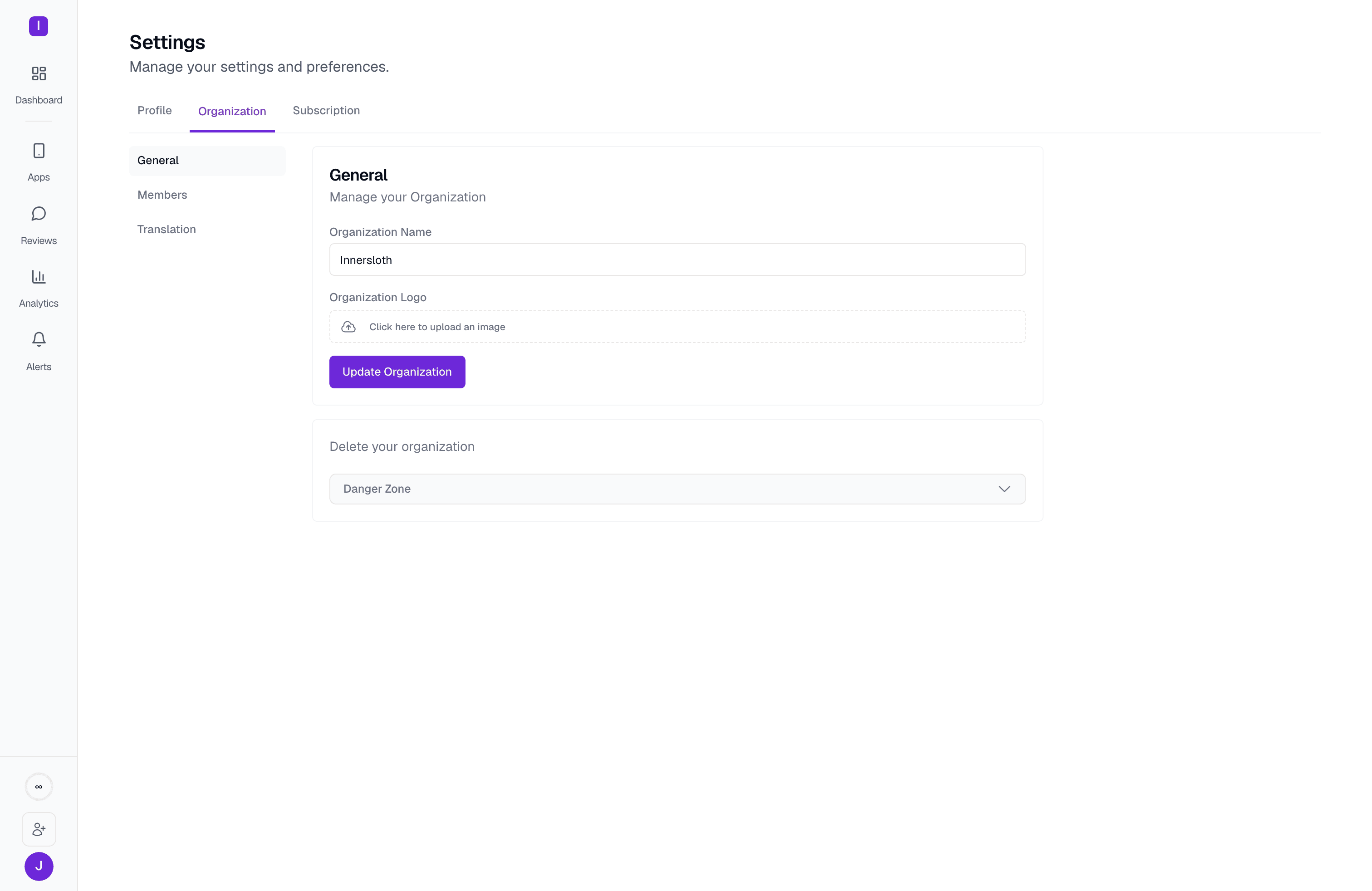
Organization settings apply to everyone in your workspace. Navigate to/dashboard/[organization]/settings to access them.
Getting started with organization setup
Organization details Set your organization name, customize the URL slug, and upload a logo. These appear throughout the dashboard and in team invitations. Building your team Send email invitations from the settings panel. Each team member gets one of three roles: Owner, Admin, or Member. Owners have full control including billing. Admins can manage apps, automations, and team members. Members focus on day-to-day review management. See User roles for details.Connecting your app stores
Link your app store accounts to enable review fetching and replies. AppReply supports Google Play, App Store, Samsung Galaxy Store, Huawei AppGallery, and RuStore. Credential storage API credentials are stored securely using Supabase Vault. Once connected, AppReply can automatically fetch reviews, monitor ratings, and post responses to your app stores.Translation preferences
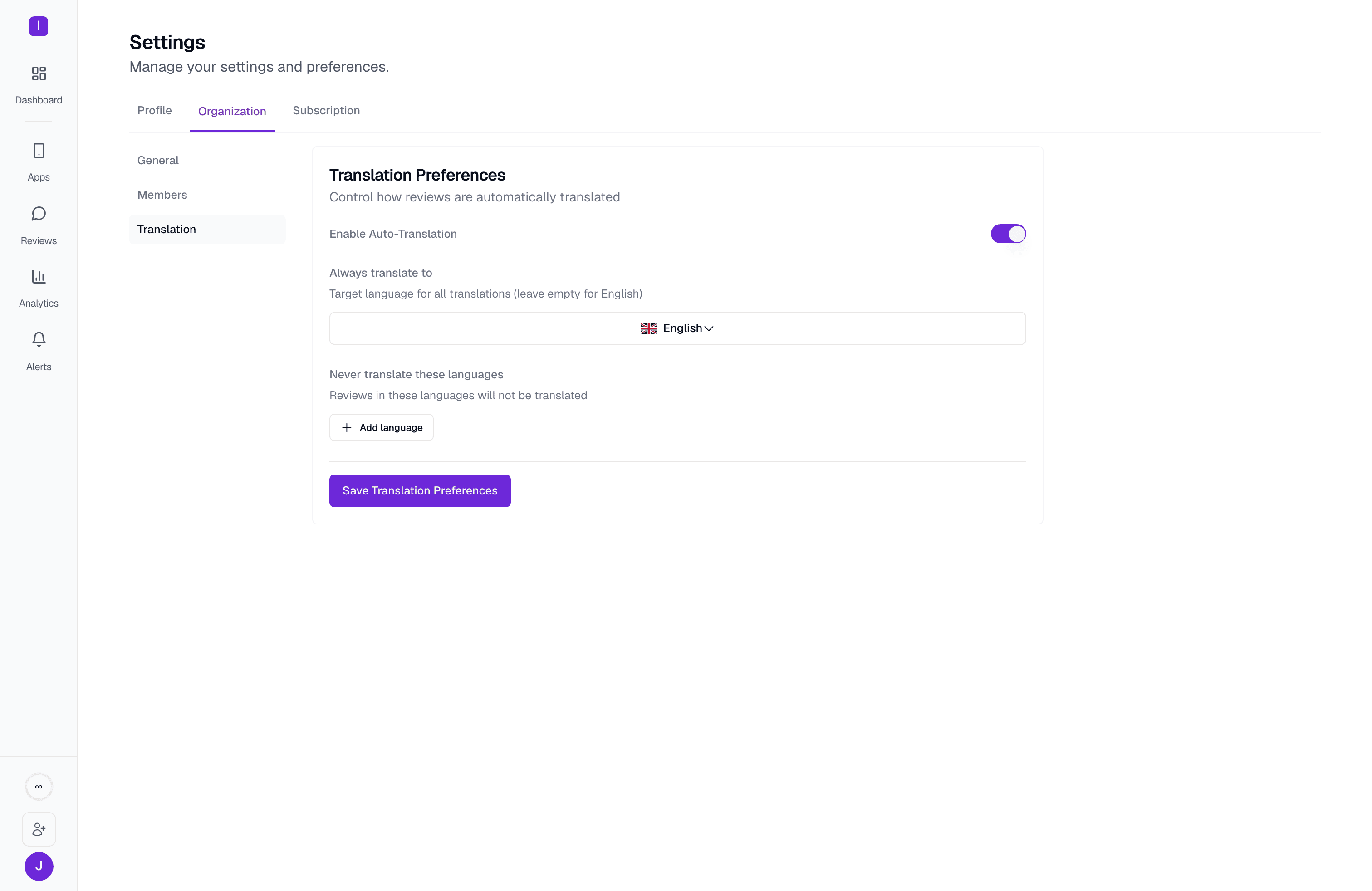
Configure how AppReply handles review translation at the organization level. These settings apply to all apps in the workspace.- Auto-translation toggle: Enable or disable automatic translation of incoming reviews. When enabled, reviews in foreign languages are translated automatically so your team can read them without switching tools.
- Target language: Choose the language that reviews are translated into. Defaults to English. Set this to whatever language your team works in.
- Never-translate list: Add languages that should not be auto-translated. This is useful if your team reads certain languages natively and does not need translations for them.
Auto-translation requires an active paid subscription (Standard plan or above).
Security and access control
Security in AppReply centers on access management. Enable two-factor authentication across your organization, configure session timeouts, and monitor access patterns through logging. Rotate API keys regularly and monitor usage to ensure credentials remain valid.Personal settings
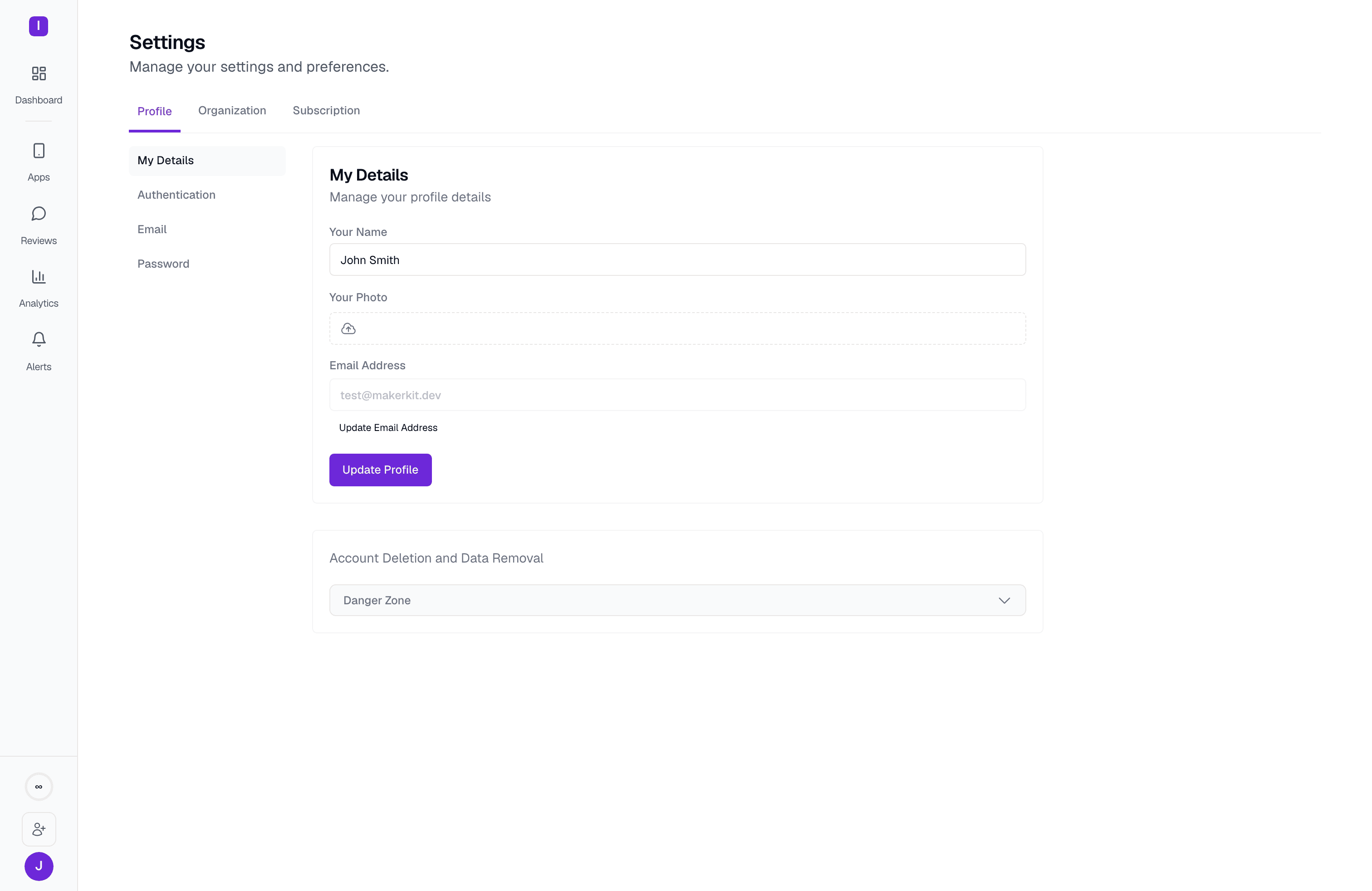
Personal settings apply to your individual account. Access them through the user menu or/dashboard/[organization]/settings/profile.
Your profile
Display and identity Upload a profile picture, set your display name, and configure your time zone so timestamps are correct in your daily workflow. Notifications Configure email alerts for events that need your attention, set up in-app notifications for real-time updates, and establish digest emails that summarize important activity. Interface Choose between light and dark themes. Set your preferred language and customize date formats.Account security
Enable two-factor authentication for your account. Monitor active sessions and review login history. Review your OAuth connections periodically and remove any integrations you no longer need.Billing management
Manage your subscription, payment methods, and usage from the billing section. See Billing for details on plans and features.Understanding your subscription
Access billing through/dashboard/[organization]/settings/billing to see your current plan, usage, and payment details.
Plan overview
View your feature access and monitor usage against plan limits. Track review processing volume, team member activity, and automation execution to understand whether your current plan fits your needs.
Plan upgrades take effect immediately, while downgrades typically apply at your next billing cycle to protect your current capabilities.
Stripe billing portal
Once your organization has an active subscription, the Manage Billing button opens the Stripe Billing Portal. From there you can update payment methods, access invoice archives, and manage subscription changes.Usage monitoring
Monitor your usage against plan limits. AppReply sends alerts when you reach 80% of various limits and provides upgrade recommendations based on your usage patterns.Multi-tenant architecture
Each organization in AppReply operates independently with separate user permissions, billing cycles, and data storage. Your settings and data are isolated from other workspaces.Best practices
- Review team member roles quarterly
- Rotate API keys periodically
- Enable two-factor authentication across your organization
- Monitor active sessions and audit access patterns regularly
Need Help?
Settings questions? Reach out through our in-app support, check our status page for service updates, or review audit logs for recent changes. We’re here to help you succeed.