

Automations send automatic replies to reviews that match rules you define, by rating, keywords, language, and more. AppReply can draft a reply for you to approve, or, if a rule is set to auto-post, publish it the moment a matching review comes in, written in the reviewer’s own language. In the dashboard, find it under Reviews > Auto-replies; the page header reads Automations.
Organize your auto-reply rules by category
Your automation rules live in five categories that mirror real support workflows: Unsorted, Positive, Ask to increase rating, Pricing, and Negative.Unsorted
Unsorted
Freshly created rules land here until you assign them to a group.Best for: Testing new rules before categorizing them properly.
Positive
Positive
Auto-respond to 4-5 star reviews with gratitude, feature announcements, or gentle requests for app store ratings.Best for: Thank you messages, feature updates, cross-promotion to other apps.
Ask to increase rating
Ask to increase rating
For users who love your app but gave 3 stars over minor issues you’ve since fixed.Best for: Rating update requests, showcasing recent improvements, feature highlights.
Pricing
Pricing
Address billing questions, subscription confusion, and pricing concerns with clear, helpful responses that reduce churn.Best for: Subscription explanations, billing support, feature value communication.
Negative
Negative
Handle 1-2 star reviews with empathy, quick triage, and paths to resolution.Best for: Bug reports, feature requests, user experience issues, damage control.
Browsing and filtering your rules
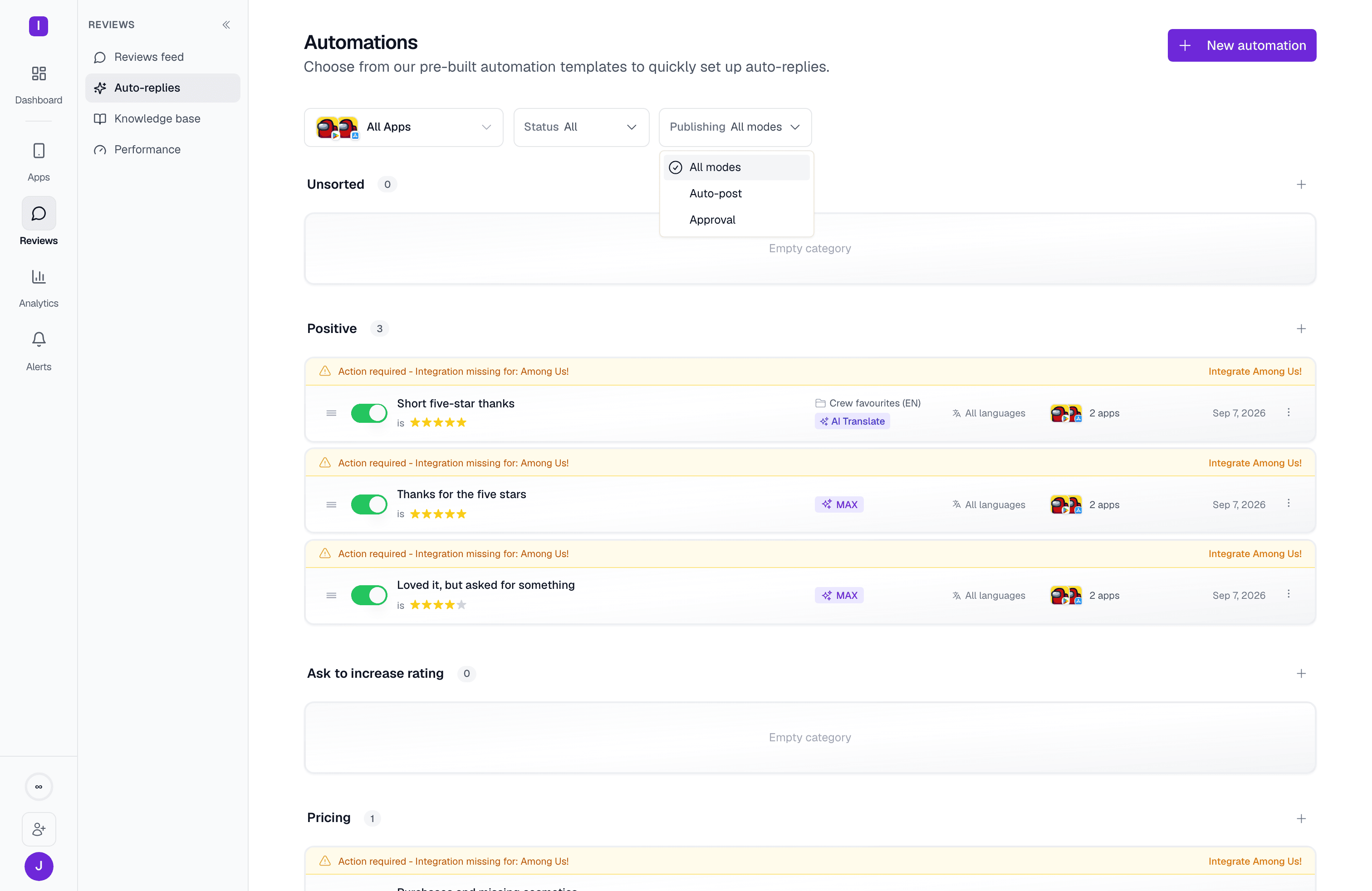
Create new automation
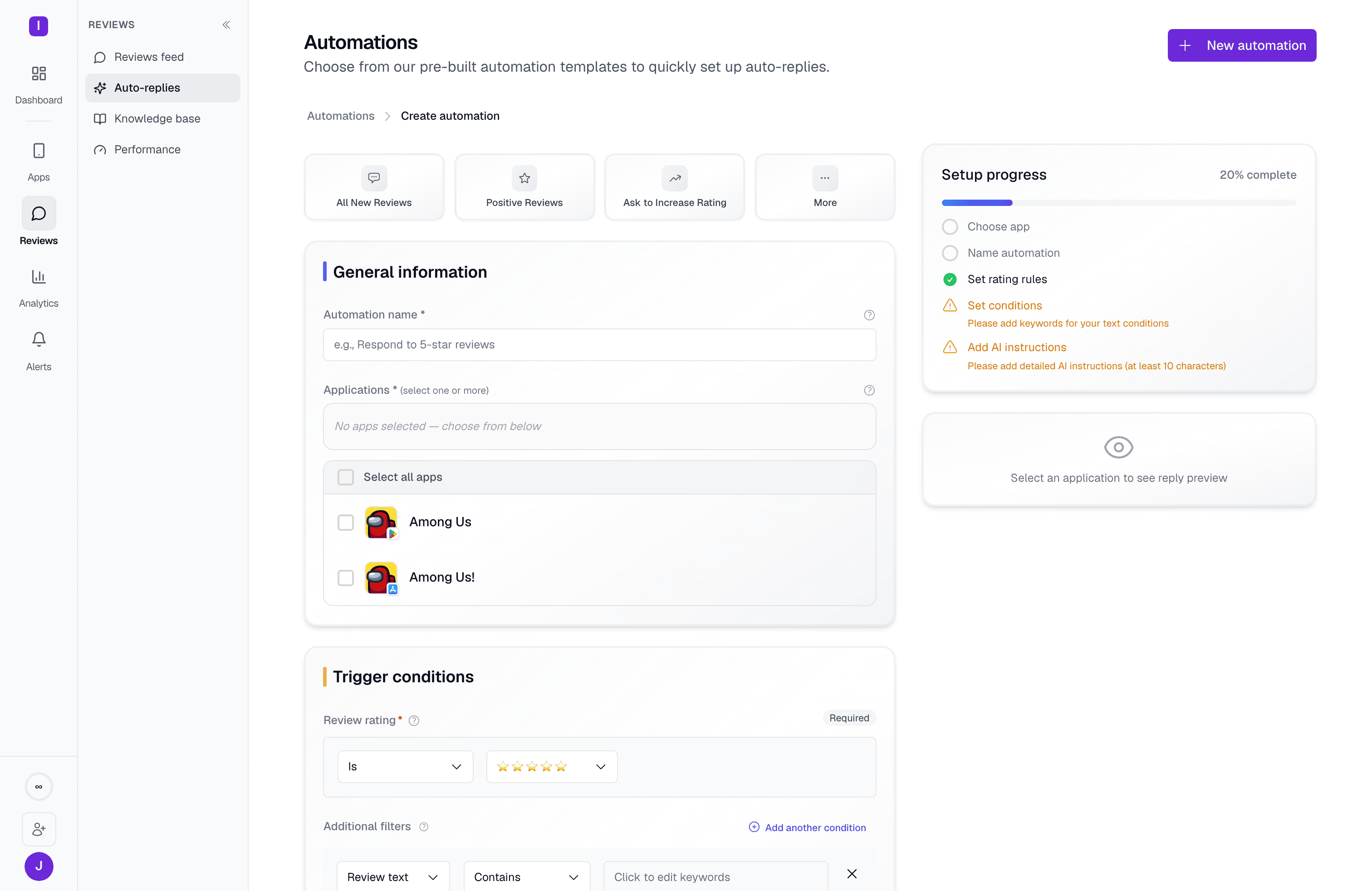
1
Name it descriptively
Use clear names like “1-star crash reports” or “5-star thank you” so you instantly know its purpose.Naming convention ideas:
[Rating] - [Topic] - [Action][Platform] - [Issue Type] - [Response Type][Language] - [User Type] - [Goal]
2
Choose your target app(s)
Select one or more apps this automation will monitor — even across platforms. Each app can have its own unique automation strategy, or share one rule.
3
Set the rating condition and any additional filters
The rating condition is required; everything else (keywords, language, length, featured status) is optional and covered in Triggers.
4
Choose a response method and, for AI, write instructions
Covered in detail in Actions.
5
Toggle enabled status
A rule can be saved disabled, so you can finish testing before it goes live.
Define trigger conditions
Every automation starts with a required rating condition, then any number of additional filters. Pick an operator — Is, Is not, More than, Less than, Equals or more, or Equals or less — and a star count from 1 to 5:- Exact targeting
- Range targeting
- Exclusion targeting
Is — target one exact star ratingIs+ 5 stars targets only 5-star reviewsIs+ 1 star targets only 1-star reviewsIs+ 3 stars targets only 3-star reviews
Choose your response method
Two ways to reply, each suited to different scenarios:Template-based responses
Select a prewritten folder of canned responses for consistency, then choose how AI enhances it:Standard reply
Use your template verbatim — predictable and consistent.Best for: Legal disclaimers, specific instructions, formal communications.
AI rewriting (recommended)
AI rewrites your canned messages each time, increasing response variety while preserving your core message.Best for: Thank you notes, apologies, general responses that benefit from freshness.
AI translation
Automatically translate your template into the reviewer’s language, supporting 94+ languages.Best for: Global apps, non-English markets, inclusive customer service.
AI rewriting and AI translation require a Standard plan or above. On a lower plan the toggle still works in the builder, but the automation saves disabled until you upgrade.
AI-generated responses
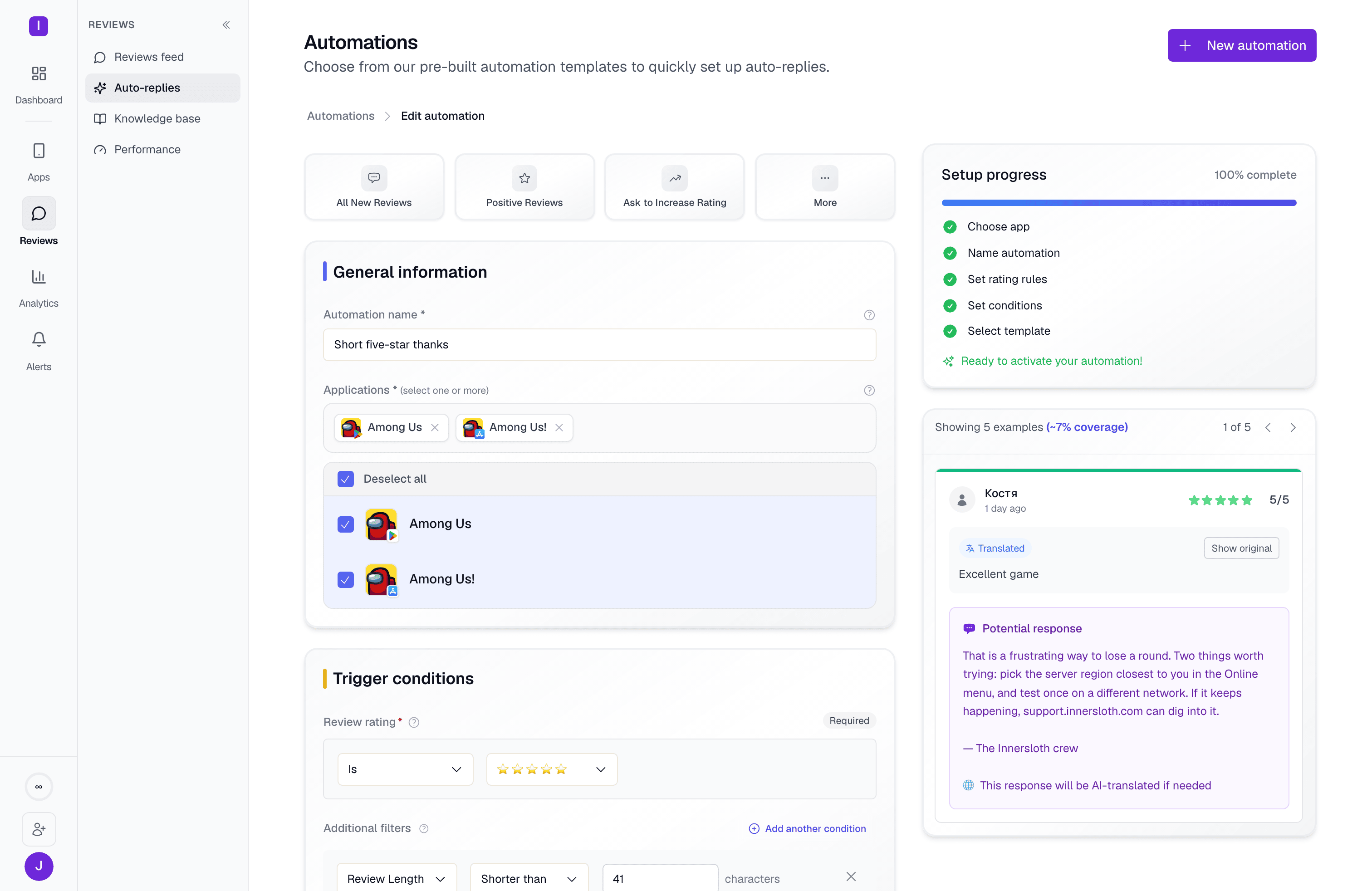
1
Provide AI instructions
Give detailed guidance (10 to 5,000 characters) to control tone, style, and content. A live indicator (Too short / Minimal / Good / Excellent) tracks length as you type.Example instruction:
2
Use quick-add chips
Fine-tune on the fly with preset options: Include greeting, Greet the user by name, Include signature, Use formal tone of voice, Use informal tone of voice, Ask to contact support team by Email or URL, and Request detailed feedback. Any custom instruction sets you’ve saved under Knowledge base > AI instructions also show up here.
3
Pick an AI intelligence tier
No Memory treats every review independently (any plan). Basic Memory grounds replies in your knowledge base and past responses (Pro plan). Agentic Memory additionally draws on approved replies and product context across your account (invite-only). See Actions for details.
Publishing and managing rules
Once your conditions and response method are set, save the automation. If Approval Mode is on (the default for new rules), replies are saved as “Pending approval” for your team to review; switch to Auto-posting Mode once you trust a rule to publish on its own.1
Test before going live
Save your automation in disabled mode first. The builder’s live preview panel shows real example reviews that currently match your conditions, with a coverage percentage and a generated potential response for each — a fast way to sanity-check the rule before it can post anything.
2
Start narrow, then expand
Begin with specific conditions (like
Is 5 stars + contains “love”) before broadening to catch more reviews.3
Edit, disable, or delete a rule
Click a rule’s name to Edit it, use its toggle to Disable it without losing configuration, or Delete it when you outgrow it. You can also Duplicate a rule to reuse its setup as a starting point — the copy always starts disabled.
Free tier limitation: You can create unlimited automations, but only 3 can be active at once on the Free plan. Paid plans raise or remove that limit.
Troubleshooting common issues
- Automation not triggering
- Wrong reviews getting responses
- Responses feel robotic
Check your conditions:
- Are they too specific? Try broadening keyword matches
- Is the app integration working? Check the “Action required — integration missing” banner on the rule
- Is the rule actually enabled, and does its Publishing mode match what you expect?
Triggers
Go deeper on every trigger condition type
Actions
Go deeper on template and AI response methods