

Start here first. Before creating automations or templates, you need to add and integrate your apps. This unlocks review fetching, replies, and automation.
Quick integration overview
Connect your apps in minutes. Each platform has its own integration method:Google Play
Connect via OAuth or upload a service account JSON key.
App Store
Use App Store Connect API keys to integrate iOS apps.
Samsung Galaxy Store
Use Samsung Seller Portal API credentials to connect.
Huawei AppGallery
Connect with Huawei AppGallery Connect API credentials.
RuStore
Use RuStore Console API credentials to connect.
Your apps dashboard
Applications lives under the Apps section of the sidebar, alongside Scorecard and Integrations. It shows every app you’ve added — your own apps and any competitor apps you’re tracking — in one grid: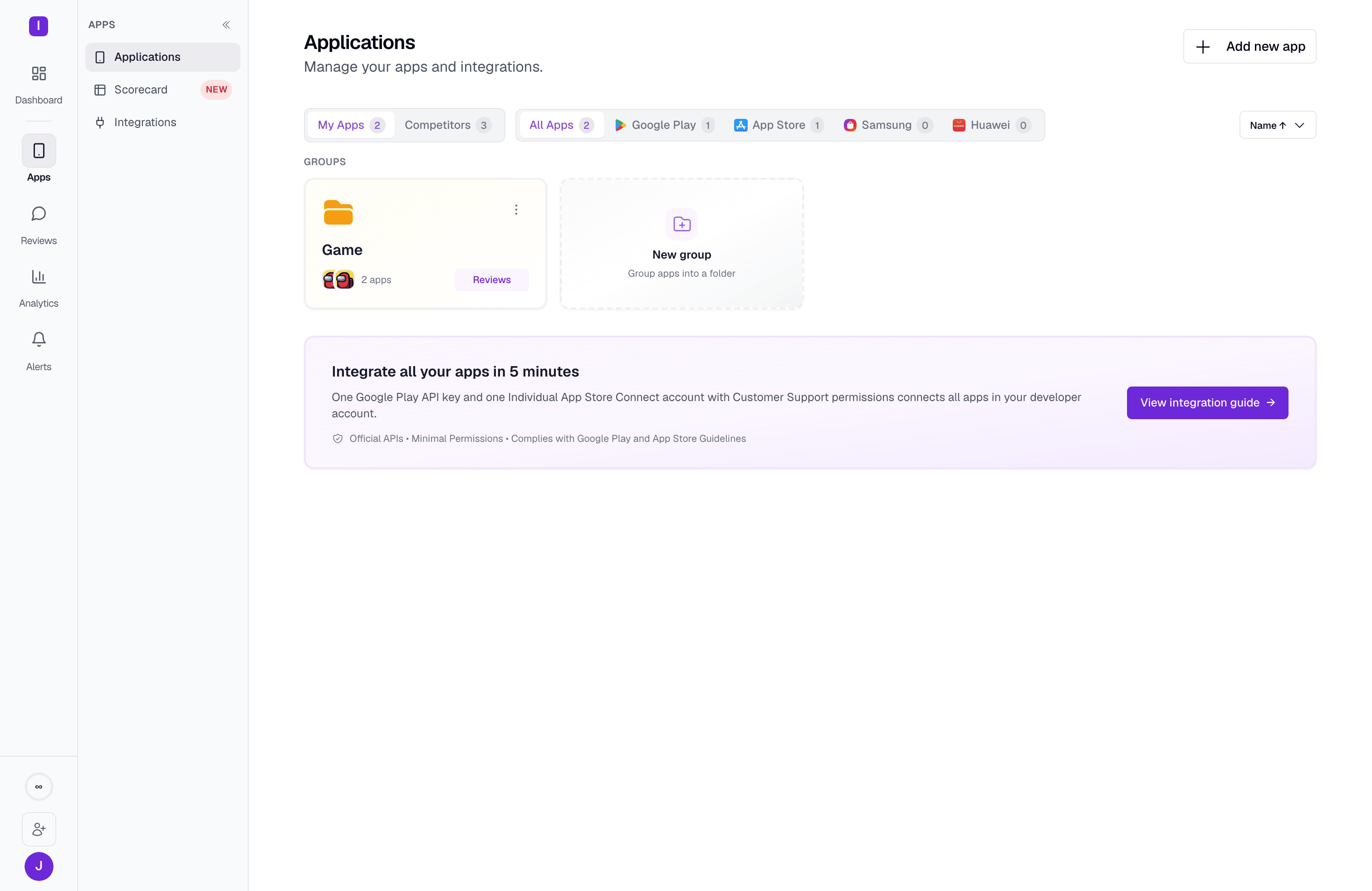
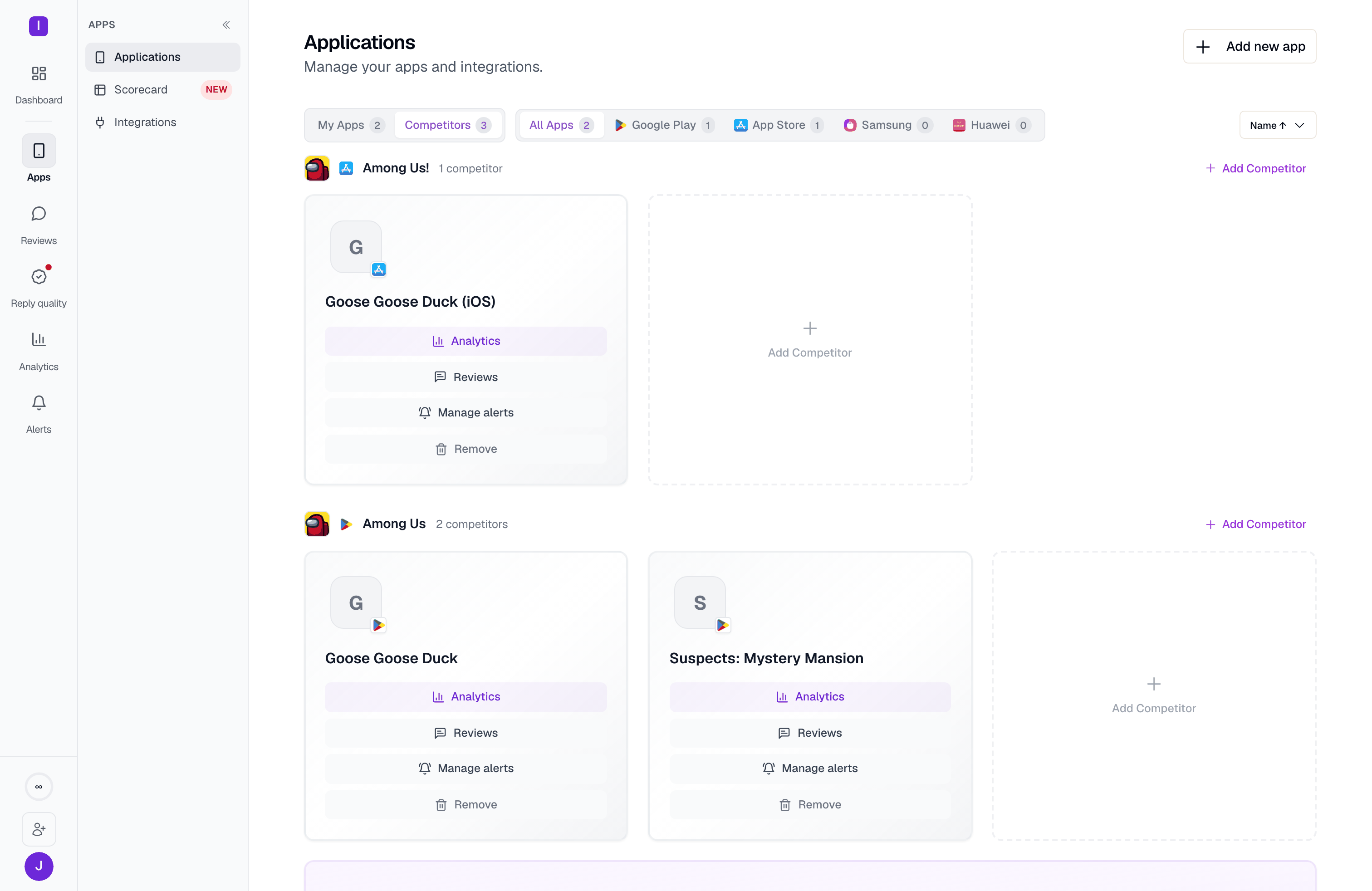
App information
App information
- App icon and name for easy identification
- Developer name for verification
- Integration status — shown as a badge on the card (see below)
Quick actions
Quick actions
- Reviews: Jump directly to the review feed for this app
- Automate (or Automations, once a rule exists): Create or manage automation rules — only shown for integrated apps
- Integrate: Complete the integration setup — only shown for apps that aren’t integrated yet
- Menu (⋮): Additional options, including removing the app
Status indicators
Status indicators
- Not Integrated (gray): No connection has been set up yet
- API Connected / a platform name like Google Play or Huawei AppGallery (green): Reviews are syncing normally
- Email Integration (blue): App Store reviews arriving via the email integration method
- An amber warning badge appears if a Google Play OAuth connection has been revoked and needs to be reconnected
Groups
Group related apps into folders — useful if you manage a family of apps under one brand, or split apps by team. From the dashboard, click New group, name it, and add apps to it. A group card shows how many apps it holds and gives you a shortcut straight into the Reviews feed for every app in the group at once.Adding an app
1
Click 'Add new app'
Click the Add new app button in the top-right corner to open the app selection modal.
2
Search or paste a URL
You have a few ways to add an app:
- Smart search: Type the app name to search across Google Play and the App Store at once. You can select up to 5 apps at a time to add in one batch.
- Direct URL: Paste the app’s Google Play or App Store URL for instant recognition.
- Add from other stores: For Samsung Galaxy Store, Huawei AppGallery, and RuStore, use the manual-entry option and enter the app’s ID and name directly.
3
Confirm and add
Review your selection and submit to add the app (or apps) to your dashboard. Each one starts out Not Integrated until you connect it.
The app detail page
Click into any app to see its full profile — the store listing AppReply holds for it, its integration state, and its AppReply activity: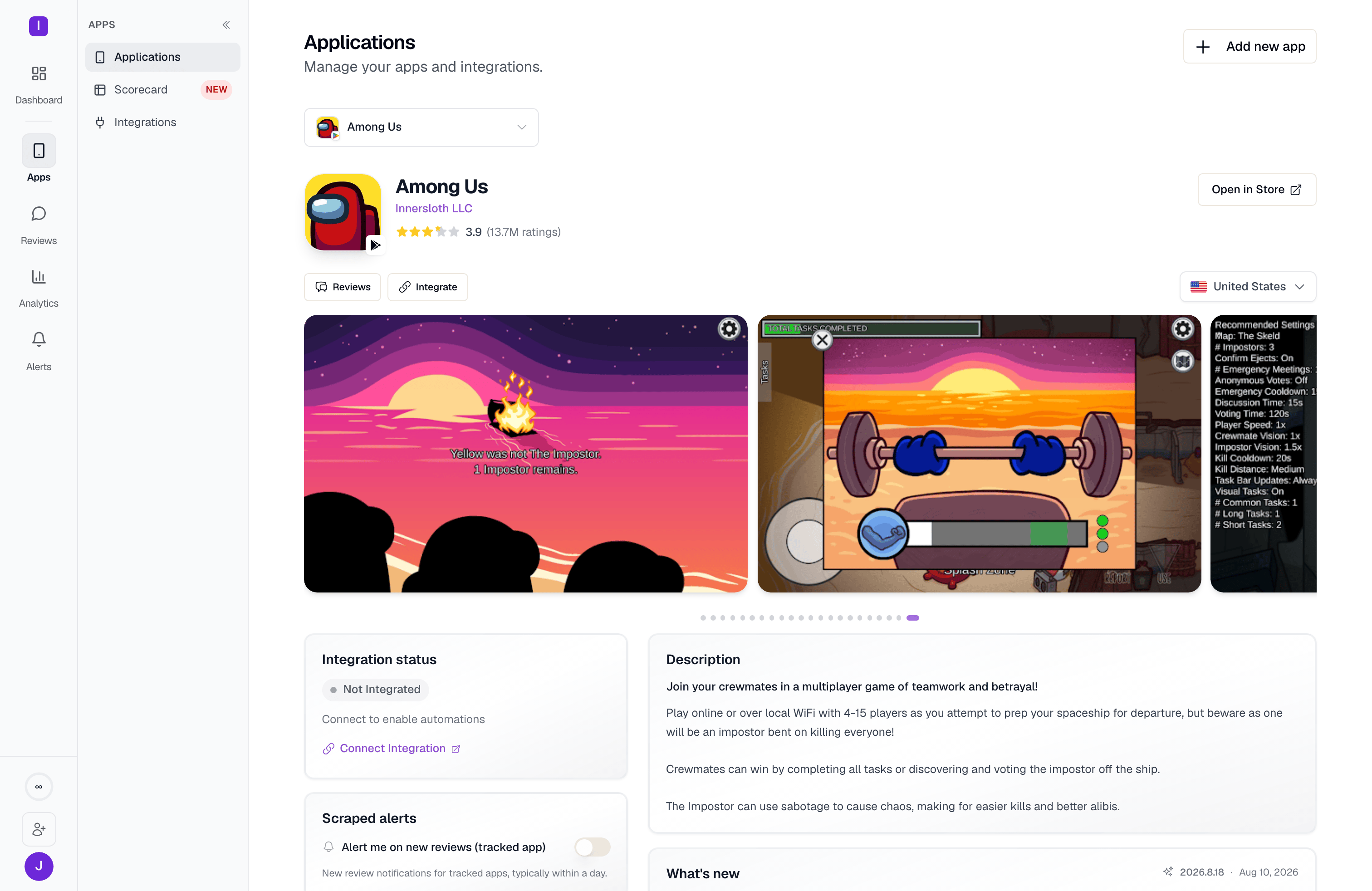
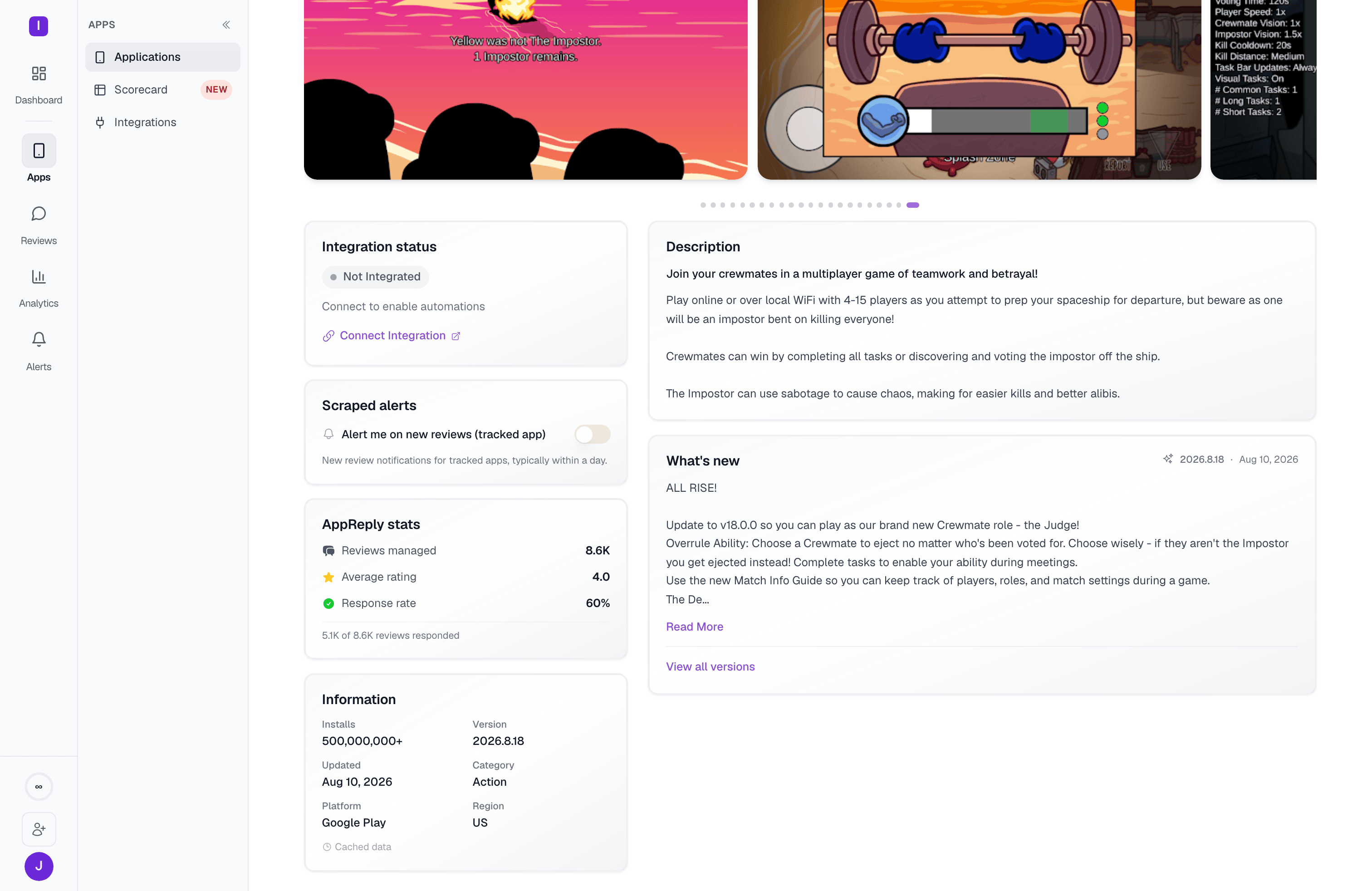
- Integration status: whether the app is connected, and a Connect Integration link if it isn’t
- Scraped alerts: a toggle for getting notified about new reviews on apps AppReply is tracking but hasn’t fully integrated
- AppReply stats: reviews managed, average rating, and response rate for this app
- Information: installs, current version, category, platform, and region, as recorded from the store
- Description and What’s new: the store listing text and the latest release notes, with a link through to full version history
Version history
Each app also has an App Updates page (linked from View all versions) that lists every release AppReply has picked up from the store, with its version number and release notes. On a newly added app, this starts out empty until AppReply has collected version data from the store.The Scorecard
While the Applications page is for managing individual apps, Scorecard (also under the Apps section of the sidebar) gives you a portfolio view: one row per app across your whole organization, for a scope, date window, and language you pick — store rating, reviews, reply coverage, and reply time, side by side.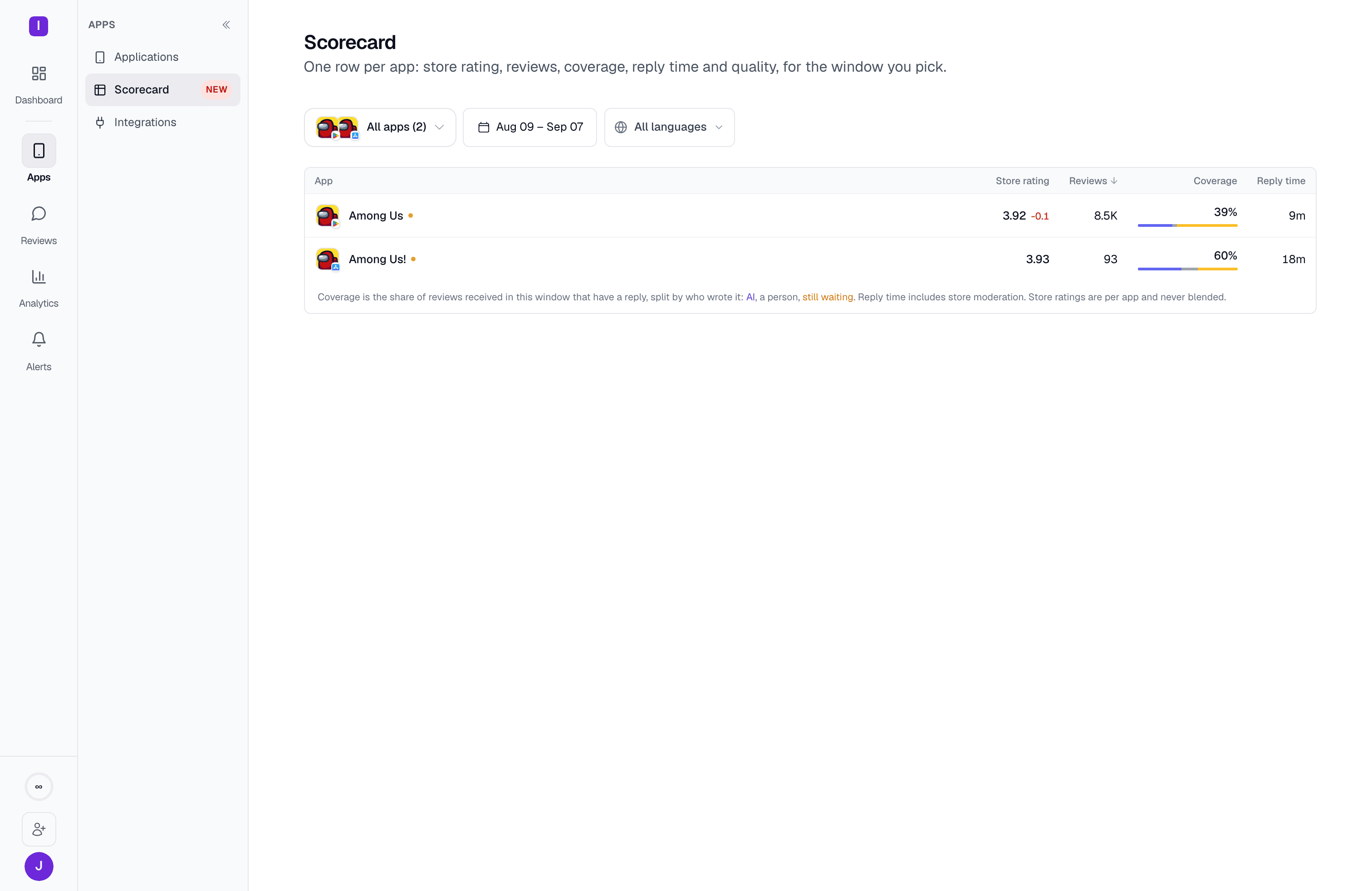
Scorecard pulls from the same underlying data as the reply-coverage numbers on your organization’s home page, so the two can’t disagree.
Integration validation
AppReply automatically validates your credentials before completing integration:What gets checked
What gets checked
For Google Play: Service account or OAuth token has valid permissions, can access the Play Developer API, and has “Reply to reviews” permission for your apps.For App Store: The Individual API key is valid and active, has the Customer Support role, and can access the App Store Connect API.For Samsung, Huawei, and RuStore: API credentials are valid and can authenticate with the respective store APIs.
Common issues
Common issues
Google Play: Service account not added to Play Console, missing “Reply to reviews” permission, or an invalid JSON key file.App Store: Using a Team API key instead of an Individual key, insufficient permissions, or an expired API key.Samsung/Huawei/RuStore: Invalid credentials, missing API permissions, or an incorrect app ID format. See each platform’s integration guide for specific troubleshooting.
Security
Security
- Minimal permissions: AppReply only requests access to read and respond to reviews
- Encrypted credentials: Store credentials are encrypted before they’re uploaded and stored as encrypted secrets, not plain text
- Official APIs: AppReply uses each store’s official developer API — Google Play Developer API, App Store Connect API, and the Samsung, Huawei, and RuStore equivalents
Plan limits
Every plan caps how many apps you can connect. Adding an app beyond your plan’s limit prompts an upgrade.You can select and add up to 5 apps in a single batch from the search modal, regardless of plan — the plan limit is what caps your total connected apps, not how many you can add at once.
Migration from other tools
If you’re migrating from an existing review management tool, you can reuse your existing API credentials:1
Locate your existing credentials
Find your Google Play service account JSON key or App Store Connect API credentials from your current tool.
2
Upload to AppReply
Use the same credentials in AppReply’s integration flow — no need to create new ones.
3
Verify permissions
Make sure your existing credentials have “Reply to reviews” permissions enabled.
4
Test the integration
AppReply validates your credentials and confirms the connection before syncing reviews.
Troubleshooting common issues
- Connection problems
- Missing apps
- Permission errors
If integration keeps failing, work through these in order:
- Verify credentials: Make sure your API keys or JSON files are correct and not expired
- Check permissions: Confirm “Reply to reviews” access in your developer console
- Review platform requirements: Double-check Individual vs. Team API key requirements for App Store Connect
- Contact support if the issue isn’t one of the above
Reviews
Manage all your app reviews in one unified dashboard
Automations
Create smart auto-replies that work around the clock