> ## Documentation Index
> Fetch the complete documentation index at: https://docs.appreply.co/llms.txt
> Use this file to discover all available pages before exploring further.
# Flagged queue
> Replies that broke a rule on your scorecard, and which of them still need you
Flagged is the triage surface for every reply that failed a criterion on its scorecard. It's built for a short, repeatable session: filter, walk the queue, mark each one handled, and stop when it reaches zero. Open **Reply quality > Flagged** in the sidebar.
 ## Needs a look vs. Handled
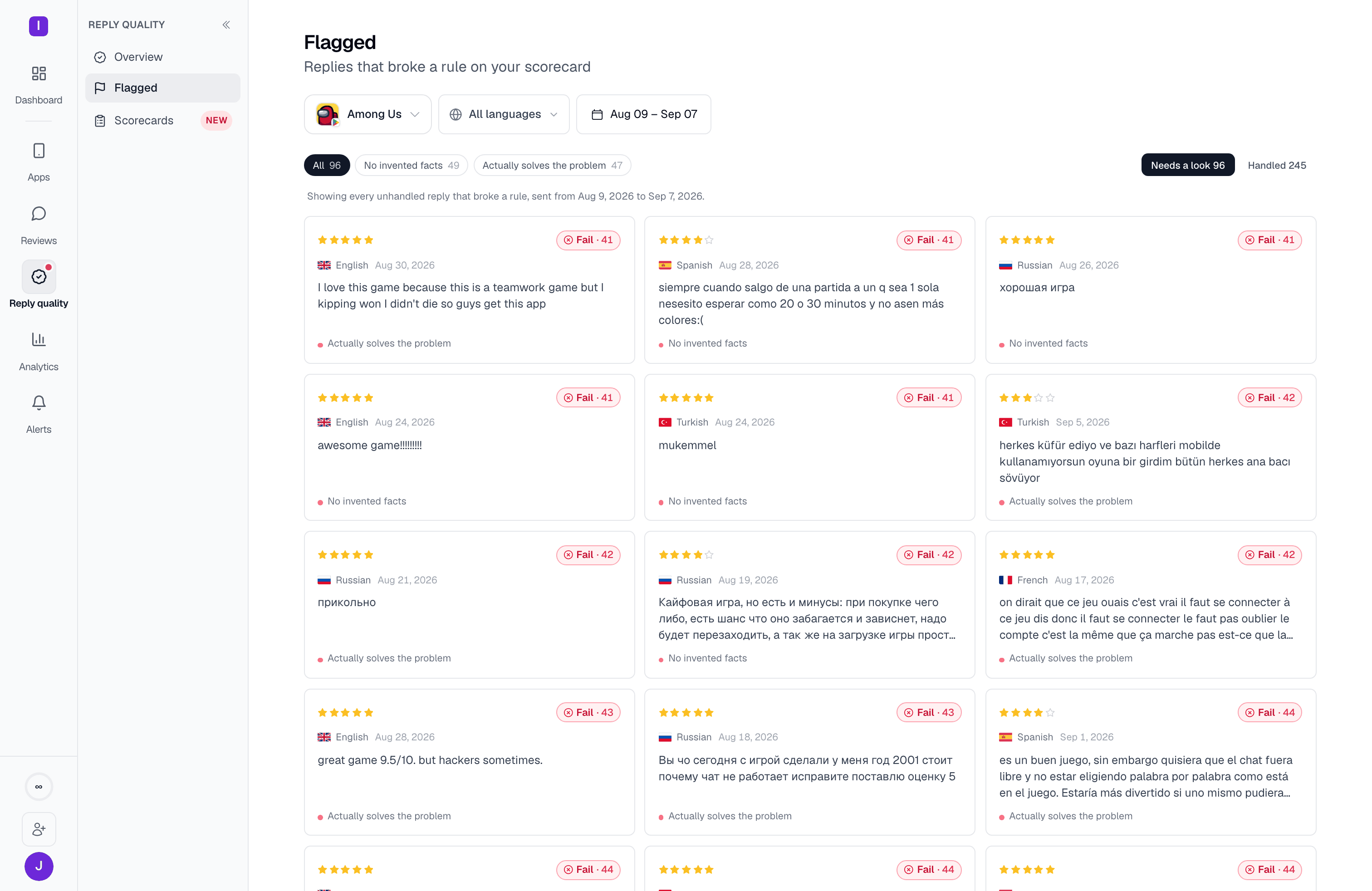
The queue opens on **Needs a look**, not on every reply ever flagged — a view that can reach zero is what makes a triage session end. Switch to **Handled** to see replies you've already worked through. Marking a reply handled removes it from Needs a look immediately; it isn't deleted, and its history stays visible under Handled.
Above the queue, chips break the current view down by which criterion failed. At a glance, you can see whether your flagged replies are many different problems or one rule catching the same mistake repeatedly — the kind of finding that turns into a single scorecard edit rather than dozens of individual fixes.
The queue's default order is worst-first: replies with a critical failure, then the lowest scores, come first. When you open Flagged from the Overview's Voice match tile instead, it opens ordered by the replies least like this app's own voice.
The Flagged queue reads the same date range, app, and language filters as the rest of Reply quality, clamped to the 90-day window replies can actually be graded in.
## Two layouts
On a wide screen the queue renders as a grid of cards, styled like an app store review, because a one-line row at that width stretches review text further than is comfortable to read. On a narrow screen it switches to a compact row list instead.
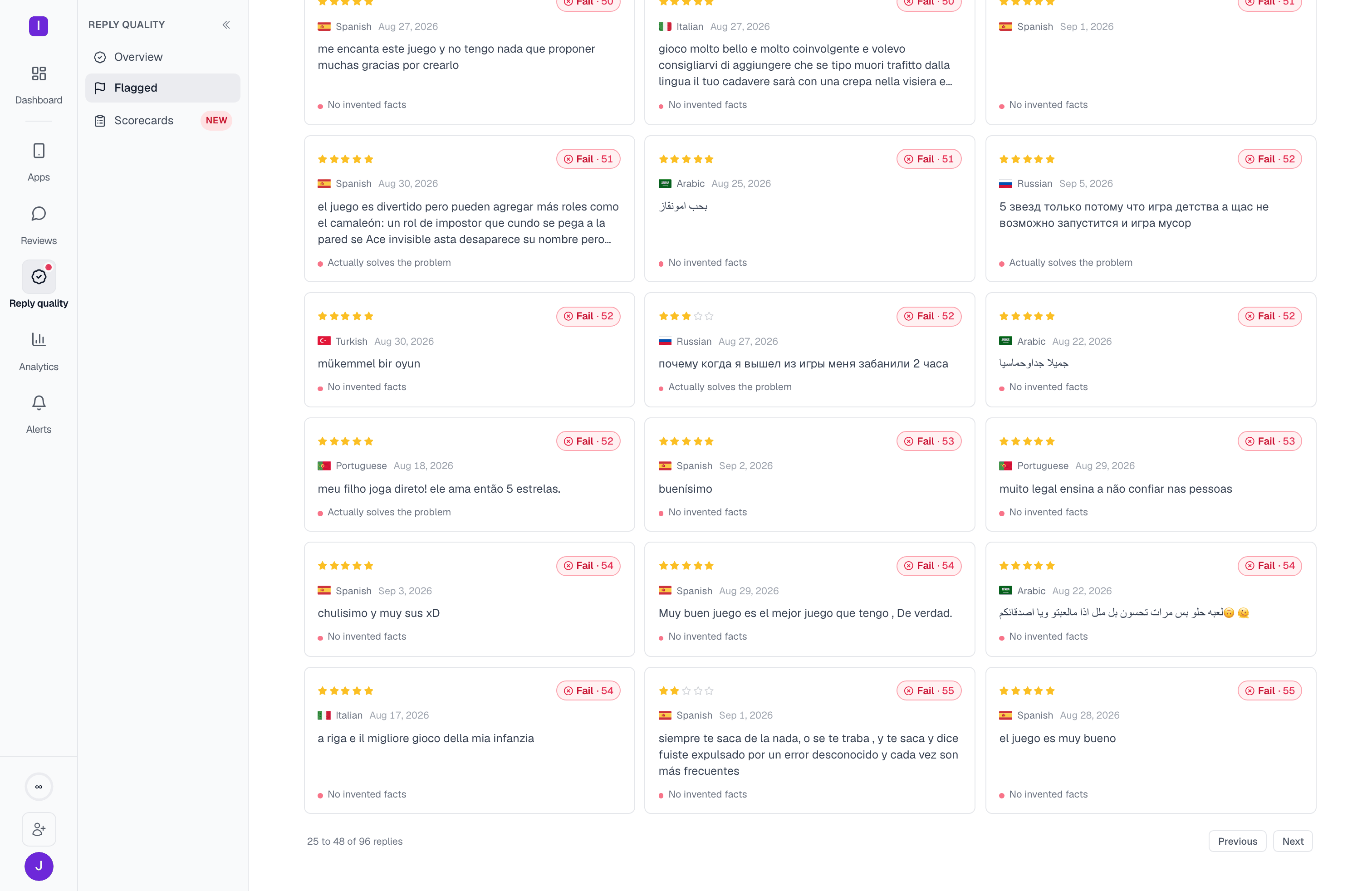
On longer queues, the page paginates rather than scrolling indefinitely:
## Needs a look vs. Handled
The queue opens on **Needs a look**, not on every reply ever flagged — a view that can reach zero is what makes a triage session end. Switch to **Handled** to see replies you've already worked through. Marking a reply handled removes it from Needs a look immediately; it isn't deleted, and its history stays visible under Handled.
Above the queue, chips break the current view down by which criterion failed. At a glance, you can see whether your flagged replies are many different problems or one rule catching the same mistake repeatedly — the kind of finding that turns into a single scorecard edit rather than dozens of individual fixes.
The queue's default order is worst-first: replies with a critical failure, then the lowest scores, come first. When you open Flagged from the Overview's Voice match tile instead, it opens ordered by the replies least like this app's own voice.
The Flagged queue reads the same date range, app, and language filters as the rest of Reply quality, clamped to the 90-day window replies can actually be graded in.
## Two layouts
On a wide screen the queue renders as a grid of cards, styled like an app store review, because a one-line row at that width stretches review text further than is comfortable to read. On a narrow screen it switches to a compact row list instead.
On longer queues, the page paginates rather than scrolling indefinitely:
 ## Opening a reply
Click any card or row to open that reply in a side panel over the queue, rather than navigating to a new page — closing it returns you to exactly where you were, scroll position and filters intact. With the panel open, j and k step to the next and previous reply in the queue without closing it.
## The graded reply view
Whether opened from the Flagged panel or its own page, one reply's detail always shows the same things, in the order you'd actually ask them:
1. The verdict
2. The original review
3. The reply as published, with the grader's cited evidence highlighted directly in the text
4. How each criterion on the scorecard scored
5. When the app has one, how this reply's language compares to the app's own voice baseline
## Opening a reply
Click any card or row to open that reply in a side panel over the queue, rather than navigating to a new page — closing it returns you to exactly where you were, scroll position and filters intact. With the panel open, j and k step to the next and previous reply in the queue without closing it.
## The graded reply view
Whether opened from the Flagged panel or its own page, one reply's detail always shows the same things, in the order you'd actually ask them:
1. The verdict
2. The original review
3. The reply as published, with the grader's cited evidence highlighted directly in the text
4. How each criterion on the scorecard scored
5. When the app has one, how this reply's language compares to the app's own voice baseline
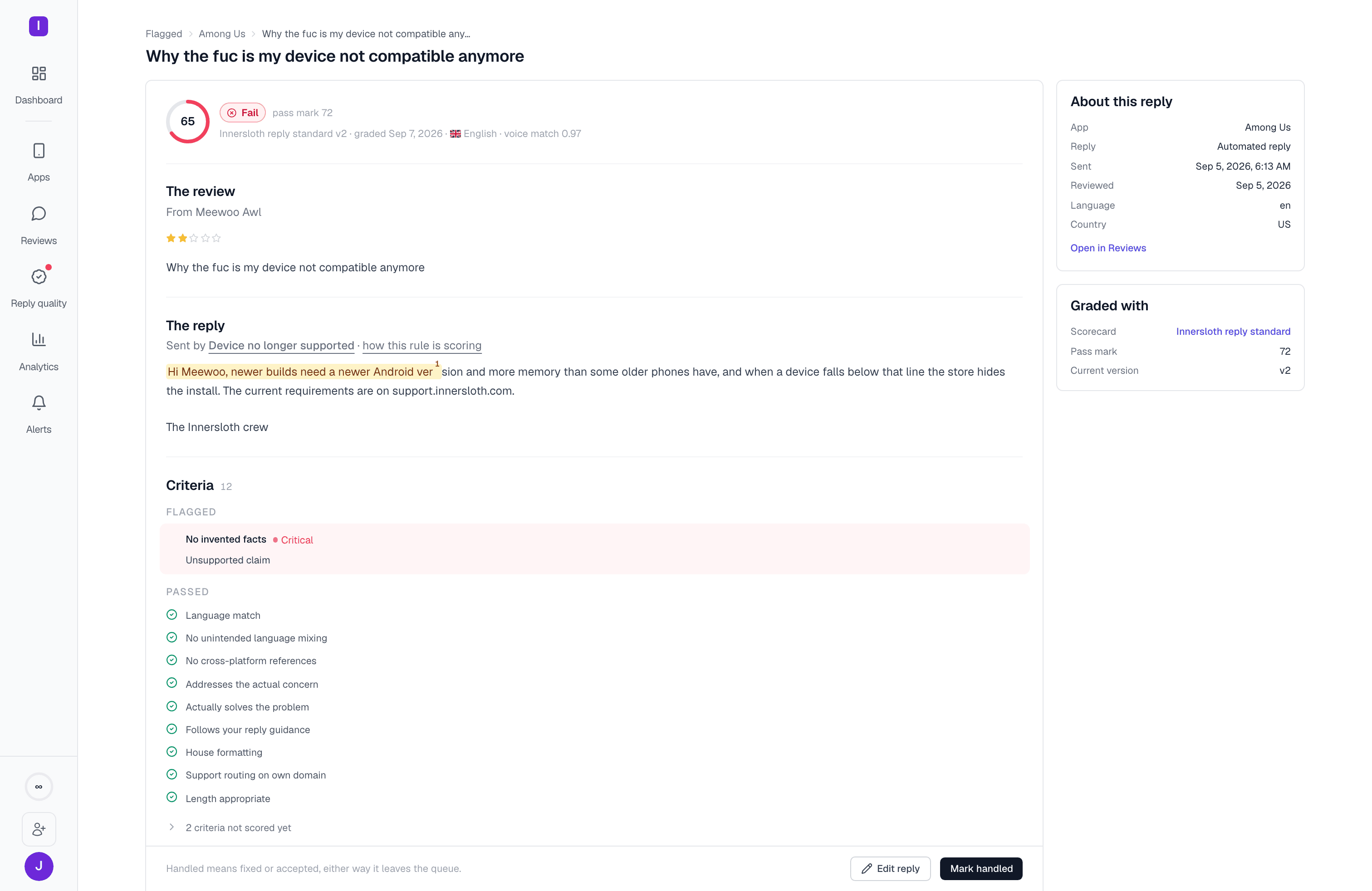 Criteria are grouped by outcome: **Flagged** first (with the reason spelled out as a sentence, and a link to the evidence highlighted above where the grader cited one), then **Passed**, then **Not scored** for anything that abstained. A criterion that abstained because its setup is missing links straight to where you'd fix that — the knowledge base, or AI instructions — rather than just naming the gap. The score itself renders as a filling ring against the scorecard's pass mark, never a bare number pretending to be self-explanatory.
From this view you can mark the reply **Handled**, or **Undo** one already marked handled back to needing a look. The action is offered on any reply that broke a rule, and again once it's handled, so the decision is always reversible.
Marking a reply handled records that a person reviewed it — it doesn't change the reply itself. To fix the underlying issue, edit the reply's automation rule, its knowledge base source, or your AI instructions, depending on which criterion flagged it.
See the verdict, trend, and voice match across the whole app
Edit the rubric that decides what gets flagged
Criteria are grouped by outcome: **Flagged** first (with the reason spelled out as a sentence, and a link to the evidence highlighted above where the grader cited one), then **Passed**, then **Not scored** for anything that abstained. A criterion that abstained because its setup is missing links straight to where you'd fix that — the knowledge base, or AI instructions — rather than just naming the gap. The score itself renders as a filling ring against the scorecard's pass mark, never a bare number pretending to be self-explanatory.
From this view you can mark the reply **Handled**, or **Undo** one already marked handled back to needing a look. The action is offered on any reply that broke a rule, and again once it's handled, so the decision is always reversible.
Marking a reply handled records that a person reviewed it — it doesn't change the reply itself. To fix the underlying issue, edit the reply's automation rule, its knowledge base source, or your AI instructions, depending on which criterion flagged it.
See the verdict, trend, and voice match across the whole app
Edit the rubric that decides what gets flagged